Restricting Abusers’ Access to Firearms Helps Prevent Violence
Early in the legislative session, Gov. Tim Walz introduced a gun violence prevention package that includes provisions to strengthen gun safety, signaling that high-profile events in the past year would heighten the legislature’s focus on gun violence prevention this year.
During session, the Women’s Foundation of Minnesota is supporting legislative efforts to implement recommendations from the state’s Domestic Violence and Firearm Surrender Task Force. The taskforce, created in 2024, was tasked with conducting a comprehensive review of firearm surrender laws for individuals under protection or risk orders, identifying best practices and procedures that enhance safety for peace officers and victims in domestic violence incidents, and providing policy and funding recommendations to the legislature. Some of our policy partners and grantee-partners sat on the taskforce and their diverse perspectives greatly enriched the recommendations. See their legislative report.
These recommendations include:
- Create a cross-sector state board on firearm surrender
- Standardize and streamline forms, procedures and data systems
- Apply surrender requirements to all firearms to create an administrative infrastructure for surrender processes
- Establish a statewide firearm surrender fund and improve storage, tracking and data collection of surrendered firearms
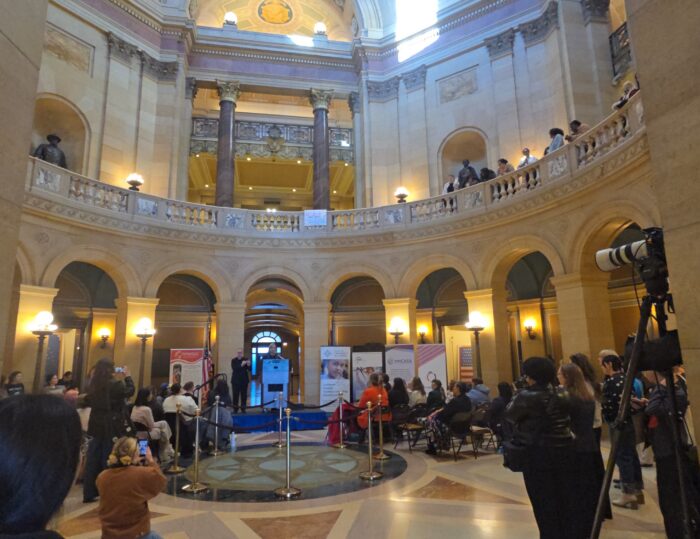
Last week, the House Public Safety Committee heard two bills aimed at getting firearms out of the hands of abusers. The bills, presented jointly by DFL Rep. Kelly Moller and GOP Rep. Peggy Scott, both passed out of committee and will move to the House Judiciary Committee for its next hearing. Both authors committed to working together to find satisfactory language to combine into one bill. In the meantime, the bills will remain separate but travel together. Rep. Moller’s bill is a comprehensive package coming from recommendations made by the Task Force on Domestic Violence and Firearm Surrender, while Rep. Scott’s bill is a much narrower bill focused on ensuring compliance hearings after a firearm restriction order is issued.
One area where the bill authors are committed to finding common ground is the prohibition of third-party firearm transfers found in Rep. Moller’s bill. Under Minnesota law, a “third party” can temporarily store or receive a transferred firearm from an individual (e.g., in cases of protective orders). In cases where a firearm transferred to an individual the abuser can manipulate (e.g., a parent, sibling, or grandparent, etc.) there is little to prevent the firearm from being returned to the abuser. For this reason, WFM would like to see the final bill require all transfers to be made exclusively to a law enforcement agency or a federally licensed firearms dealer.
Safety Requires Freedom from Violence
To thrive, women, girls, and gender-expansive people must be free from violence in every environment – at home, school, the workplace, and in their communities. For the Women’s Foundation of Minnesota, living a safe and healthy life includes the right to bodily autonomy, to have children, not have children, and parent the children we have in safe and sustainable communities.

And yet, women, girls, and gender-expansive people in Minnesota are harmed by gender-based violence throughout their lifetimes: in their homes, on the streets, and in schools, workplaces, and the criminal justice system. The consequences of this violence, whether witnessed or personally experienced, include poor mental health outcomes, chronic disease and health problems, unwanted pregnancy, substance abuse, homelessness, lost economic productivity, and a lack of personal freedom, as cited in the Status of Women & Girls in Minnesota.
According to Violence Free Minnesota, a statewide coalition of over 90 member programs working to end relationship abuse, in 2024, gun violence was the cause of death for 62 percent of the victims of intimate partner violence as well as bystanders and intervenors. At least 24 children lost a parent to intimate partner violence in the same year. One of the risk factors for deadly intimate partner violence can be an abuser’s access to a firearm.
Katie Kramer, the co-executive director of Violence Free Minnesota said, “Nearly every year in Minnesota, firearms are overwhelmingly the most common means of intimate partner homicide. They are also the number one cause of death for bystanders and intervenors who are killed in acts of domestic violence. Guns don’t just endanger survivors, but also their children, their friends, their neighbors, and the law enforcement and medical responders who try to help them.”
Violence is Preventable
Advocates, including Violence Free Minnesota share that intimate partner violence is preventable. Multiple systems and service touchpoints hold opportunities to identify and address partner violence, including public health, social services, community-based services, and housing systems. Within these systems, addressing gun violence at the legislature and supporting the leadership of community advocates like Protect Minnesota and Violence Free Minnesota, WFM believes that additional protections will ensure safety for more Minnesotans.
As part of working upstream to prevent violence, the Women’s Foundation also invests in programs that promote healthy relationships, health education in schools, and support for survivors of violence. At the Capitol, WFM works to increase support for Crime Victim’s Services and Safe Harbor, so that systems for survivors have the resources they need to meet the demand.
Freedom from gun violence and intimate partner violence is another dimension of investing in violence prevention. According to Katie Kramer, “Preventing domestic violence will require all of us: individuals, communities, policymakers, and systems players. No one approach alone will create a violence free Minnesota – it will require a coordinated effort to reduce access to and use of firearms in order to create a safer state for us all.”