2026 Status of Women & Girls in Minnesota Executive Summary
Women in Minnesota are leading – in schools, at home, in health care, nonprofits, as activists, and in elected office – caring for families and our communities. Minnesota is second in the nation for women’s participation in the workforce, but women remain segregated in lower-paying industries, experience high rates of violence and harassment, and steep barriers in access and affordability of health care. We must close the gaps in earnings, safety, health, and leadership – especially for Black, Indigenous, and women of color who face disproportionate barriers in every area. Together, let’s make sure Minnesota women, girls, and gender-expansive people have what they need to thrive.
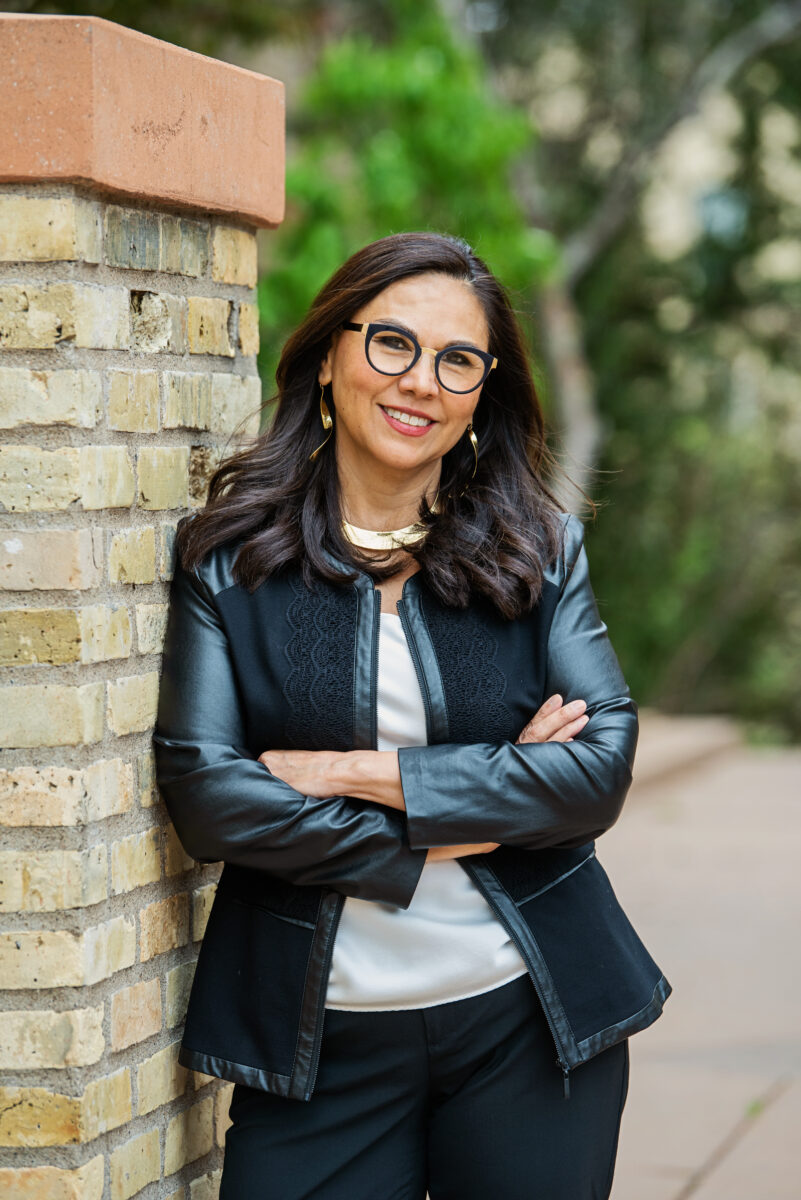
Gloria Perez | President & CEO, Women’s Foundation of Minnesota
Tap the “+” to expand each section of the Executive Summary.
Section 1: Economics
Minnesota can do more to open pathways to economic security for women and girls. Minnesota women remain segregated in lower-paying industries, and race and gender have an outsized impact on average earnings. For Minnesota women to achieve economic security, we need to raise pay in occupations dominated by women, ensure all workers have access to a living wage, and encourage women’s participation in high-paying trades.
Wealth Gap
Minnesota has the fifth-largest racial wealth gap in the United States. In Minnesota, the median net worth of Black households is $0, compared to $211,000 for white households and $18,000 for Latina/o households.1 Nationally, U.S. white families have a median family wealth of $250,400 compared to Black families’ median wealth of $24,520.2
Debt is a key impediment to wealth generation for women. Nationally, women have 74% more student debt per dollar of income and 14% more credit card debt per dollar of income compared to men.3 Single female household heads are also more likely to be unbanked (not served by a bank or other financial institutions) and more likely to accumulate payday loan debt.4
Wage Gap
The gender wage gap is shaped by several factors, including differences in education, work experience, and the types of jobs men and women tend to hold. But even after accounting for these factors, part of the gap remains.
This remaining difference is usually attributed to gender bias in the workplace, including discrimination. Gender biases that directly contribute towage disparities also indirectly influence factors like occupational choice and years of paid employment.
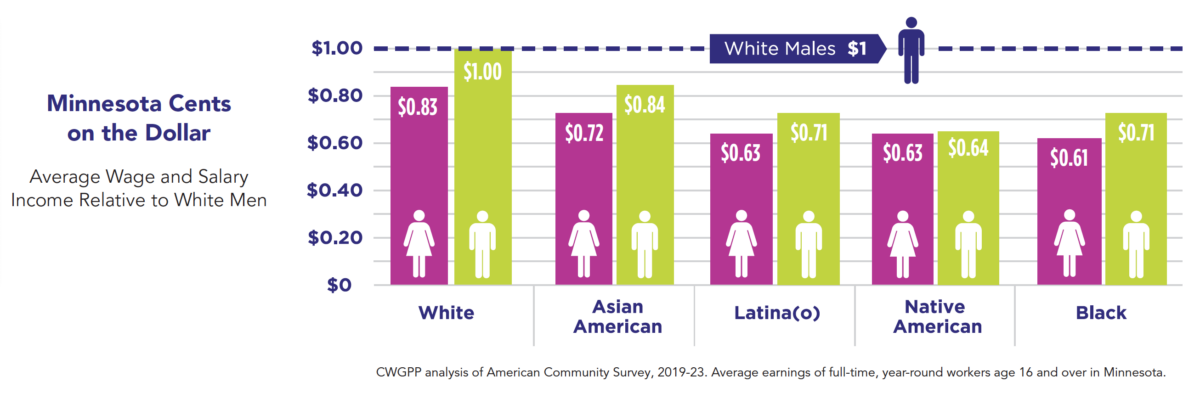
Black, Indigenous, and women of color face the most significant income disadvantages. These compound inequalities have lasting effects on women’s economic security, opportunities for advancement, and lifelong earnings.
The gender wage gap has a lifetime impact. Minnesota is the 18th worst state in the nation for lifetime losses due to the wage gap. Today’s wage gap costs a woman in Minnesota $415,960 over a 40-year career when compared to a man. Asian women in Minnesota lose an estimated $745,640, while Black, Latina, and Native American women lose more than $1 million over a lifetime.5
Immigration and refugee status intersects with gender to compound economic disparities. The wage gap is 1.6 times as large for Somali women, 1.3 times as large for other African immigrants and Hmong women than it is for white women in Minnesota.6
On average, Minnesota women who work full-time, year-round, earn 81 cents for every dollar that men make, with significant disparities by race and ethnicity.
Average Wage and Salary Income Relative to White Men
Occupational Segregation
Women are disproportionately concentrated in low-wage service occupations, which are less likely to offer full benefits, and remain underrepresented in higher-paying trades and STEM fields. This occupational segregation is a key factor contributing to the gender wage gap.
Women are more likely to work in care and service-related occupations that are relatively underpaid, and less likely to have access to benefits. Women account for over 80% of employees in healthcare and personal care occupations, and more than 70% of employees in office and administrative support, education, and community and social service occupations. In contrast, men account for more than 97% of employees in construction, 83% in militaryrelated occupations, 79% in farming, and over 70% of employees in computer and production occupations.7
Women of color and Native American women are concentrated in service occupations. Overall, women constitute 19% of service workers in Minnesota. While 17% of Minnesota’s white women work in service jobs, 33% of Black, 31% of Native American and 27% of Latina women workers work in service fields where benefits are scarce. By comparison, 12% of men work in these occupations.8
Ninety-four percent (94%) of child care workers in Minnesota are women, and they are low-paid.9 As a consequence of high rates of poverty and food insecurity, nearly half of U.S. child care workers (46%) relied on at least one of four public safety net programs (EITC, TANF, SNAP, CHIP) in 2021, compared to 19% of elementary/middle school teachers and 28% of the entire U.S. workforce.10 Minnesota child care workers earn a median hourly wage of $16.43.11
Education & Training
Minnesota high school girls take fewer career and technical education (CTE) courses than boys, ultimately impacting the gender wage gap. Girls take fewer of these courses, and the courses they take are less aligned with the job market than those boys take. As a result, male students have more opportunities to obtain in-demand job skills training in high school and earn high wages with a high school degree, while women students must rely on postsecondary credentials, which are much more costly.12
Child Care
Based on the standard federal recommendation on child care costs, only 7% of Minnesota two-parent families can afford infant child care.13 The average cost of center-based infant care in Minnesota is more than the annual cost of tuition and fees at the University of Minnesota.14 15
High-quality child care is out of reach for many Minnesota families, especially those headed by women. In Minnesota, there are 258,978 children whose parents are employed but only 169,450 available child care slots.16 Between 2002 and 2022, Greater Minnesota lost 20,000 slots in child care centers and 35,000 slots in family care centers, compared to the Twin Cities’ loss of 2,600 child care slots.17
Poverty
Women are more likely than men to experience poverty in Minnesota. In 2023, 11% of Minnesota women were living below the poverty level, about 1.1 times the poverty rate for men and slightly more in Greater Minnesota than in the Metro area.18
Single female-headed households are among the most vulnerable to poverty in Minnesota. Twenty-five percent (25%) of single, female-headed households with children in Minnesota live below the poverty line.19
Housing
Households headed by single women spend more than the recommended federal guideline of 30% of monthly income on housing. 66% of Minnesota’s families headed by single mothers who rent their homes and 45% of those who own their homes are paying housing costs that exceed 30% of their income. The rate is even higher for Latina single mothers in rental housing: 74% pay over 30% of family income on housing, and 33% pay over half of their income.20
LGBTQ+ people are overrepresented among the unhoused. Only 4% of Minnesotans identify as LGBTQ+, yet 13% of unhoused individuals identify as LGBTQ+.21
Unhoused women in Minnesota are more likely than unhoused men to be parents and living with a child. About 62% of unhoused women report being a parent of at least one child (under 18) compared to 35% of unhoused men. Around 59% of unhoused women had a child with them at the time of the survey interview compared to 22% of unhoused men.22
The Twin Cities has the largest Black-white homeownership gap among similar metro areas.23 The Black-white homeownership gap in the Twin Cities is nearly 42% – 20 percentage points higher than the best performing cities among its peers (Austin, Atlanta, and San Francisco).24 While Minnesota’s overall homeownership rate has remained relatively stable at around 72% since the 1970s, Black homeownership rates in Minnesota have declined almost every decade since the 1960s. Currently, only 26% of Black Minnesotans own homes – less than half the statewide rate.25
Section 2: Safety
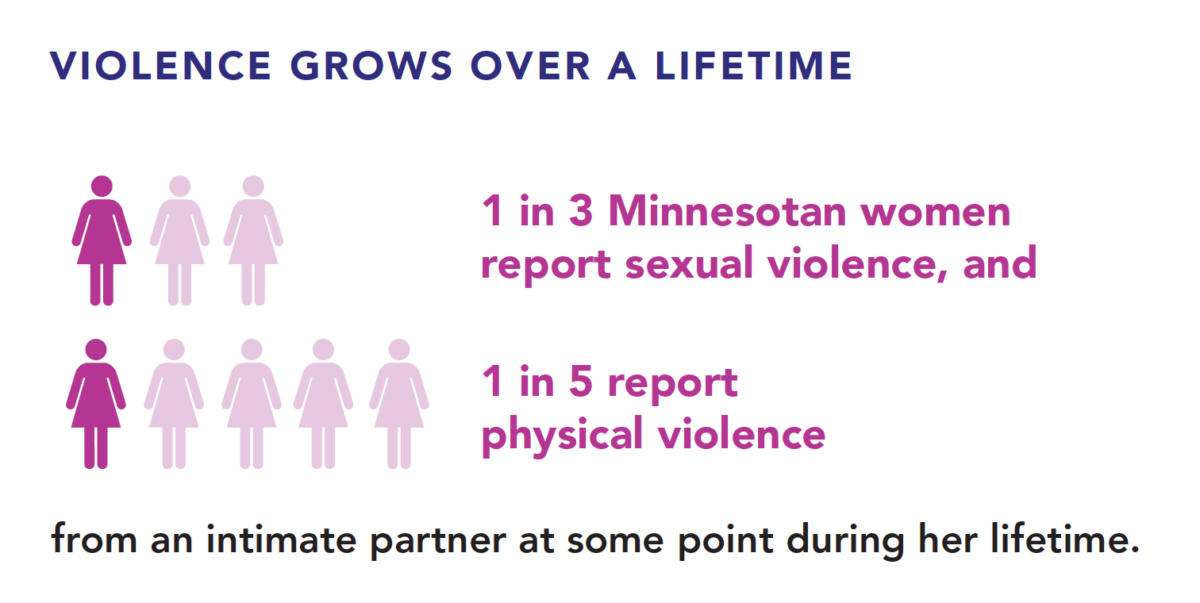
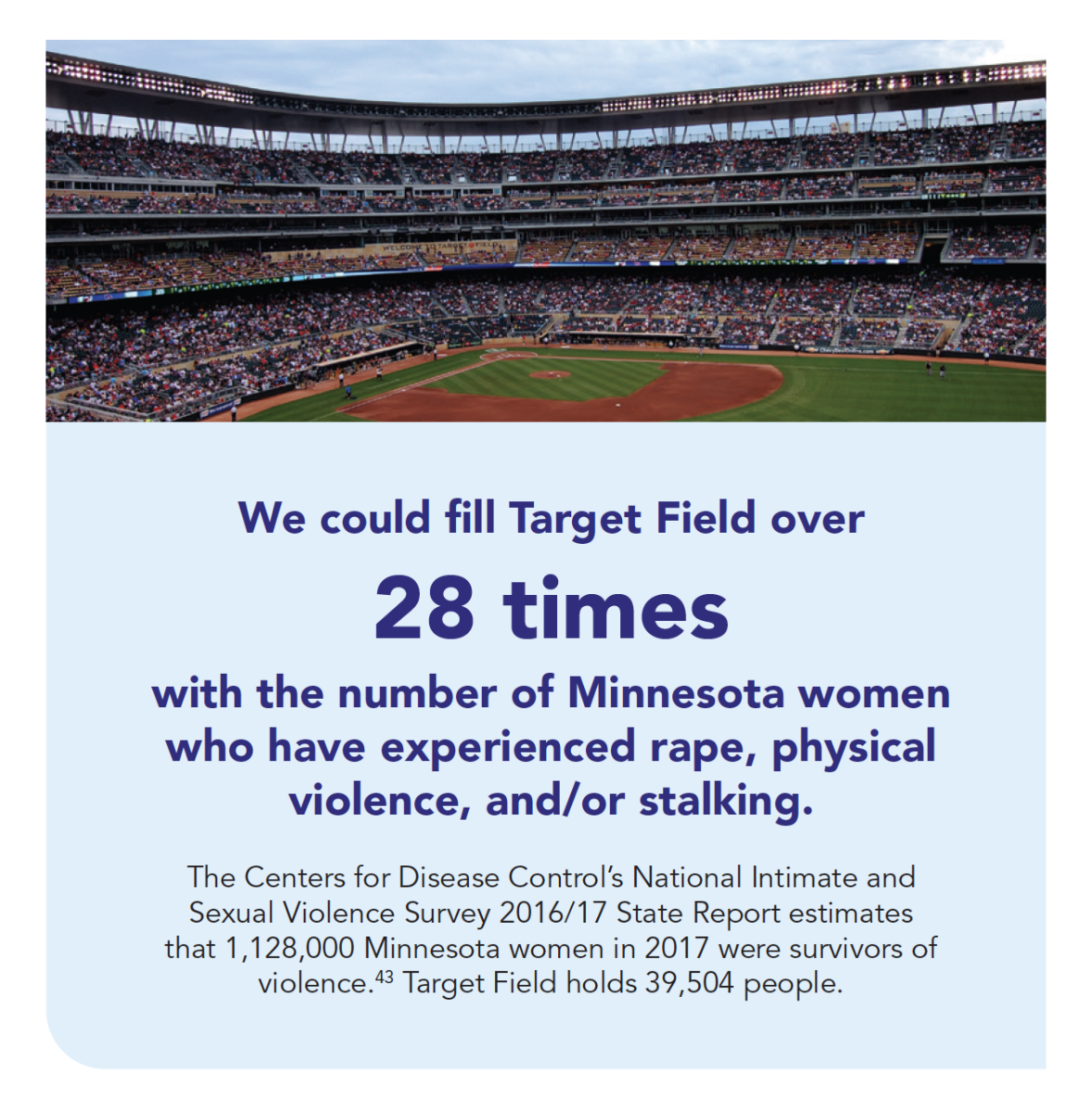
True safety depends on safety for all people. Women, girls, and gender-expansive people in Minnesota are harmed by gender-based violence throughout their lifetimes: in their homes, on the streets, and in schools, workplaces, and the criminal justice system. Consequences of witnessing or experiencing violence ripple over a lifetime and include poor health outcomes, unwanted pregnancy, substance abuse, housing, economic productivity, and personal freedom.
Harassment & Bullying
Sixty-three percent (63%) of Minnesota women have been sexually harassed.
Women are at an increased risk for sexual harassment in the workplace. In 2024, 37% of women nationally reported experiencing some form of sexual harassment in the workplace, compared to 14% of men.26 Women in male-dominated fields face an elevated risk of harassment.
More than half of young LGBTQ+ Minnesotans report experiencing anti-LGBTQ+ behavior in the past year. In a 2024 survey, 57% of Minnesota respondents aged 13-24 reported discrimination based on their sexual and/or gender identity and 23% were threatened or harmed due to their sexual and/or gender identity.27
Intimate Partner Violence
Native American women face high rates of violence. In the U.S., over 80% of Native American women have experienced some form of violence in their lifetime. Native American women are 19% more likely than white women to have experienced violence at some point in their lives, and 71% more likely to have experienced violence in the past year. 38% of survivors were unable to access the essential services they required and were two times as likely as white women to lack access to these services.28
Minnesota domestic violence service providers provide important support for victims. Local domestic violence programs provided housing and support to a total of 1,561 adults and children victims affected by domestic violence. In addition, 763 adult and child victims received nonresidential supportive services to address various needs, including legal assistance, housing advocacy, transportation, mental health support, and public benefits. However, victims made 196 requests for services that service providers were unable to fulfill due to resource limitations. Of these unmet requests, around 60% were specifically for emergency shelter, hotels, motels, or other forms of housing.29
Domestic violence victims often need housing to escape but cannot obtain it. In 2018 in Minnesota, 52% of unhoused women over 18 stayed in an abusive situation because they did not have other housing options, compared to 26% of unhoused men.30
Immigrant Survivors of Intimate Partner Violence
Immigrants experiencing intimate partner violence have fewer places to turn for help. In January 2025, the Trump administration rescinded the Biden-era policy that declared churches, schools, hospitals, and social service agencies protected from immigration enforcement.
The lack of safe places to seek help for domestic violence or complete asylum processes has had a chilling effect on immigrant survivors of violence, in Minnesota and beyond. Victims are less likely to seek support and more likely to remain in violent relationships.31

Section 3: Health
Health is a collective responsibility that requires public institutions dedicated to safeguarding our shared well-being and proactively identifying and working to reduce health inequalities. Reducing health disparities and increasing positive health outcomes for all Minnesota women and girls requires a living wage, freedom from violence, access to affordable and healthy foods, safe housing and neighborhoods with clean air and water, mental health services, adequate time for rest and opportunity for physical activity, and policies that ensure affordable access to high-quality health care.
Health inequities for Black, Indigenous, and women and girls+ of color, LGBTQ+ people, women and girls with disabilities, and rural women and girls+ lead to significant differences in health care access, quality, and outcomes in Minnesota.
Prenatal & Obstetric Care
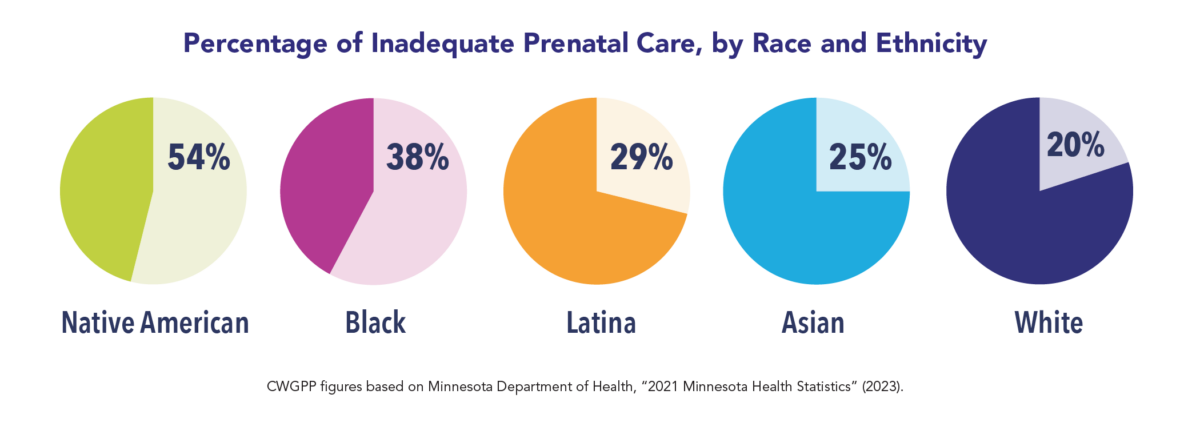
Access to prenatal care is unequal across race and ethnic groups in Minnesota. Eighty percent (80%) of women in Minnesota in 2021 received prenatal care in the first trimester of their pregnancy. However, that access diverges sharply across racial groups. White women report the highest rates of care beginning in the first trimester (84%) while Native American women report the lowest rates (55%).32
Black and Native Minnesota women are disproportionately more likely to die from pregnancy or childbirth, while Latina maternal mortality has been on the rise. Black Minnesotans constitute 13% of the birthing population but account for 26.7% of pregnancy-associated deaths, while Native American Minnesotans make up 1.7% of the birthing population but represent 12% of pregnancy-associated deaths.33 Minnesota was also one of the top five states with the largest percentage increase of maternal mortalities for the Latina population (greater than 105%) between 2009 and 2019.34
Access to Abortion
Minnesota has experienced a rise in abortions since the Dobbs decision. Between April 2022 and April 2024, abortions increased by 42% (from 950 to 1,350).35 Much of the increase is due to patients traveling from states with restrictive laws or bans. In Minnesota, 83% of abortions in 2023 were for Minnesota residents.36
Rural Health Care
The 10 counties with the highest teen birth rates are all in Greater Minnesota. While Hennepin and Ramsey Counties offer robust access to sexual health services with 52 clinics operating five days a week, access is far more limited in rural Minnesota – only 54.7% of rural counties have even a single clinic located within the county.37
Minnesota’s decline in rural obstetric services outstrips the national average. Continuing a decline begun in 2000, between 2013 and 2023, 18 Minnesota counties have lost or reduced birth services.38
Rural Minnesota has a shortage of healthcare providers, particularly in primary and mental health care. A disproportionate number of rural medical facilities have closed, and rural hospitals often have fewer services available.39
Food Security
Nearly 2 in 3 participants in Minnesota’s Supplemental Nutrition Assistance Program (SNAP) are women.40 Participation in SNAP is disproportionately higher among non-white women: almost 24% of Native American women, 22% of Black women, and 15% of Latina women used SNAP in the past year compared to 7% of white women.41
Women who are low-income, women who live in rural areas, and single heads of household face the highest barriers to healthy food access.42 In 2023, households led by single mothers showed a higher rate of food insecurity at 35%, compared to 23% in single-father households and 11% in married-couple households.43 U.S. older women of color and older women with disabilities are disproportionately food insecure.44
Mental Health
Economic status affects women’s mental health. Poverty is a significant risk factor for mental health issues and stress, and people of color and Native Americans in Minnesota disproportionately live in poverty.45 Low-income women are exposed to more uncontrollable life events, dangerous neighborhoods, and job insecurity, among other risks.46 Prior research has found a two-way relationship between mental health and poverty: decline in socioeconomic status leads to a decline in mental health and poor mental health leads to a decline in socioeconomic status.47
Minnesota teenage girls are two to three times as likely to attempt suicide as teenage boys (12% vs 5%). Almost one in three Native American teenage girls has attempted suicide.48
LGBTQ+ Minnesotans report high rates of mental distress. Four out of five (80%) of respondents to a 2021 Minnesota survey of LGBTQ+ Minnesotans reported experiencing moderate to severe mental distress.49
Only 27% of the demand for mental health professionals in Minnesota is met.50 Approximately 80% of Minnesota counties are designated to have a shortage of mental health professionals.51
Cost & Access
Healthcare costs in Minnesota are a greater barrier for women of color and access has worsened. In 2023, 25% of Latinas, 21% of Native American women, 11% of Black women, and 12% of Asian women reported that they could not see a doctor because of costs in the previous 12 months, while 8% of white women reported the same.52 This is a significant decline in access over 2021 when 10% of Black women and 14% of Latinas, and 5% of Asian women in Minnesota reported that they could not see a doctor because of costs in the past year.53
Section 4: Leadership
Research shows that gender, racial, and other types of diversity in leadership and representation bring clear benefits, from economic innovation to deeper community support for democratic institutions.54 Whether it’s the halls of Congress or corporate boardrooms, women leaders – particularly those who represent a range of socioeconomic, racial, and ethnic backgrounds – often bring different perspectives and experiences to the decision-making process.
Minnesota has a long way to go to achieve gender parity in leadership at nearly every level. When we look at business, nonprofits, and government together, women make up just three in 10 leaders statewide. Women hold a greater share of nonprofit and government leadership roles, but even in those sectors, men outnumber women leaders two to one.55
Business
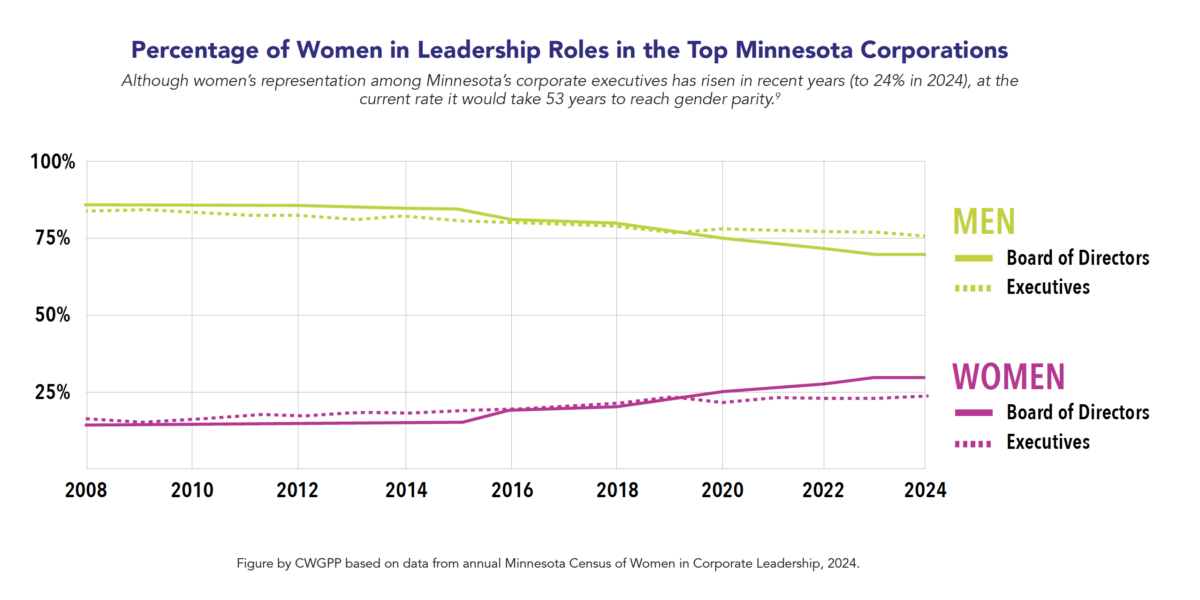
Although women’s representation among Minnesota’s corporate executives has risen in recent years (to 24% in 2024), at the current rate it would take 53 years to reach gender parity.56
Nonprofits
Women make up the majority (74%) of Minnesota nonprofit sector employees,57 but between 2018- 2022, only 40% of nonprofit CEOs in Minnesota were women.58
Only 22% of Minnesota nonprofit leaders were people of color in 2018-2022. Nevertheless, this is a significant increase from 2012-2016 when only 1% of nonprofit leaders were people of color.59
Politics
Women bring different experiences to the political process. Women legislators introduce more legislation than men related to women’s rights, children, and family. Women of color and Native American women bring unique community perspectives to elective office; Black and Latina women focus especially on issues and interests of their communities.60
Women legislators out-perform men. At the federal level, congresswomen secure about 9% more federal outlay money than congressmen.61 When congresswomen are in the minority party, they continue to build coalitions, leading to greater legislative success, while congressmen more often choose to hinder policy change.62
The proportion of women in the Minnesota Legislature was 37% in 2025, down from the historic high of 39% in 2023.63 Minnesota dropped to 20th place nationwide for state legislatures with the largest proportions of women in 2025. Overall, Minnesota ranks 9th in the nation for women’s political representation in all elected office.64
Voting
Since 1980, women in the U.S. have been more likely than men to vote in every presidential election.65 In Minnesota, 79% of women voted in the 2024 general election, 6% higher than men.66
Education
On average, girls have higher levels of participation in student government and other leadership activities than their male peers, with significant variation by race and ethnicity. Overall, 8% of teenage boys and 11% of teenage girls in the state participate in these activities.67
Policy Solutions
Steps towards greater equity can – and must – be pursued by employers, organizations, and individuals, as well as policy makers. Some solutions are specific, and some are simply a start on pathways to policies that center equity.

Economics
The building blocks of economic security include pay equity, education and training, stable living-wage jobs with benefits, avoiding debt, accumulating wealth, and robust retirement assistance. To achieve economic security, women must also have access to affordable and reliable caregiving supports such as child care, elder care, and paid leave.
- Close the gender wage gap
- Provide support for care responsibilities
Safety
Working upstream means investing in prevention, education, and targeting solutions identified by groups most impacted by violence.
- Provide comprehensive support to survivors of violence
- Address the root causes of violence
- End violence against Native American and Black women and girls in Minnesota
- Support survivors of human trafficking in Minnesota
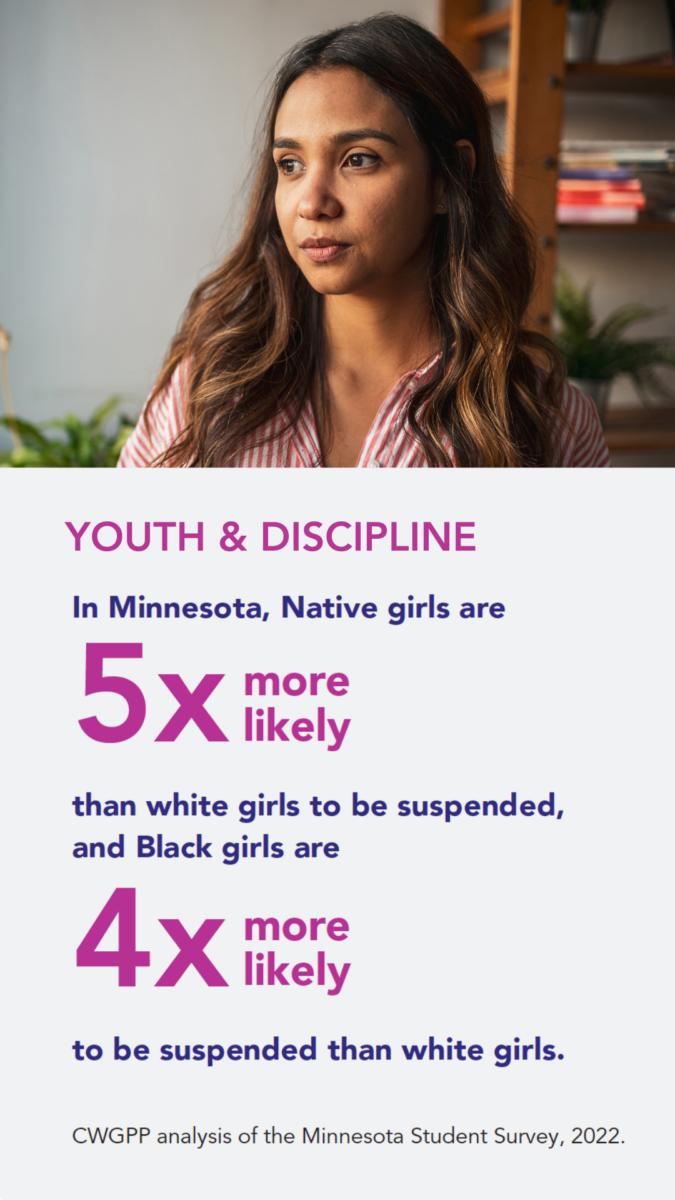
- Address racial and gender inequities in school discipline
Health
Increasing access to culturally relevant, community-based preventative health care inclusive of mental and reproductive health will support stronger health outcomes in all communities.
- Close gaps in sexual and reproductive health
- Make the building blocks of health available to all
- Improve access to high-quality and affordable health care
- Promote cultural competence among health care providers
Leadership
Gender, racial, and other types of diversity in leadership has clear benefits. Institutions across sectors can grow their pathways to leadership by increasing access to policymaking and public service and setting and maintaining standards for recruitment and retention.
- Diversify leadership in workplaces and corporate boards
- Facilitate the participation of marginalized groups in civic engagement and politics
Acknowledgments
A team of researchers from the Center on Women, Gender, and Public Policy (CWGPP) at the University of Minnesota’s Humphrey School of Public Affairs conducted the research in summer 2025 and wrote this report. The team was led by Professor Christina Ewig, Ph.D., director of the CWGPP, and included Esraa Mahmoud (Ph.D. student), Nadia Jackson-Fitch (Ph.D. student), and Professor Caroline Krafft, Ph.D. (University of Minnesota’s Humphrey School of Public Affairs). Jayne Swift (CWGPP communications manager) provided editorial coordination and support. Any views, opinions, or recommendations expressed in this report belong to its creators and do not reflect official views, opinions, or recommendations of the University of Minnesota.

At the Women’s Foundation of Minnesota, Sara Gangelhoff (Director of Advocacy and Innovation) and Jen Lowman Day (Senior Director of Communications) provided editorial direction.
Endnote References
- Ben Horowitz et al., Systemic Racism Haunts Homeownership Rates in Minnesota (Federal Reserve Bank of Minneapolis, 2021), https://
www.minneapolisfed.org:443/article/2021/systemic-racism-haunts-homeownership-rates-in-minnesota. ↩︎ - Adam McCann, “States with the Biggest and Smallest Wealth Gaps by Race/Ethnicity in 2025,” WalletHub, accessed June 22, 2025, https://wallethub.com/edu/states-with-the-highest-and-lowest-financial-gaps-by-race/9842. ↩︎
- Lucia F. Dunn & Ida A. Mirzaie, “Gender Differences in Consumer Debt Stress: Impacts on Job Performance, Family Life and Health.” ↩︎
- Mark Pearce, 2021 FDIC National Survey of Unbanked and Underbanked Households (Federal Deposit Insurance Corporation, 2021), https://www.fdic.gov/analysis/household-survey/2021report.pdf. ↩︎
- National Women’s Law Center, The Lifetime Wage Gap, State by State (National Women’s Law Center, 2025), https://nwlc.org/resource/the-lifetime-wage-gap-state-by-state/. ↩︎
- CWGPP analysis of American Community Survey 2019-2023, American Community Survey 5 Year Estimates. ↩︎
- CWGPP analysis of American Community Survey 2019-2023, American Community Survey 5 Year Estimates. ↩︎
- CWGPP analysis of American Community Survey 2019-2023, American Community Survey 5 Year Estimates. ↩︎
- CWGPP analysis of American Community Survey 2019-2023, American Community Survey 5 Year Estimates. ↩︎
- Caitlin McLean et al., Early Childhood Workforce Index 2024 (Center for the Study of Child Care Employment, 2024), https://cscce.berkeley.edu/workforce-index-2024/the-early-childhood-educator-workforce/early-educator-pay-economic-insecurity-across-the-states/. ↩︎
- University of Minnesota, “Boynton Health College Student Health Survey (CSHS).” ↩︎
- Alessia Leibert, The Gender Math Gap and Its Effects on Earnings, Minnesota Employment Review (State of Minnesota, 2022), https://mn.gov/deed/newscenter/publications/review/october-2022/gender.jsp#header. ↩︎
- Health and Human Services Department, “Child Care and Development Fund (CCDF) Program, 45 CFR 98, 81 FR 67438, 2015.,” Federal Register, December 24, 2015, https://www.federalregister.gov/documents/2015/12/24/2015-31883/child-care-and-development-fund-ccdf-program. ↩︎
- Child Care Aware® of America, “Child Care in America: 2024 Price & Supply.” ↩︎
- Office of Admissions, “Cost of Attendance,” University of Minnesota, 2025, https://admissions.tc.umn.edu/cost-aid/cost-aid-scholarships/cost-attendance. ↩︎
- First Children’s Finance, “Child Care Needs Summary 2024” (Rural Childcare Innovation Program, 2024), https://www.ruralchildcare.org/data. ↩︎
- Kelly Asche, Child Care in Rural Minnesota after 2020 (Center for Rural Policy and Development, 2021), https://www.ruralmn.org/child-care-in-rural-minnesota-after-2020/. ↩︎
- CWGPP analysis of American Community Survey 2019-2023, American Community Survey 5 Year Estimates. ↩︎
- CWGPP analysis of American Community Survey 2019-2023, American Community Survey 5 Year Estimates. ↩︎
- CWGPP analysis of American Community Survey 2019-2023, American Community Survey 5 Year Estimates. ↩︎
- Wilder Research, 2023 Minnesota Homeless Study: Statewide Interview Data. ↩︎
- Wilder Research, 2023 Minnesota Homeless Study: Statewide Interview Data. ↩︎
- Greater MSP, MSP Regional Indicators Dashboard 2021 (Minneapolis Saint Paul Regional Economic Development Partnership, 2021), https://www.greatermsp.org/clientuploads/2021_Regional_Indicators_Dashboard_Final.pdf. ↩︎
- Libby Starling et al., “After Recent Successes, Twin Cities Region’s Housing-Supply Progress Slips,” Federal Reserve Bank of Minneapolis, January 2, 2025, https://www.minneapolisfed.org/article/2025/after-recent-successes-twin-cities-regions-housing-supply-progress-slips. ↩︎
- Jeff Howison, Demographic Trends in Minnesota Homeownership (Minnesota State Demographic Center, 2024), https://mn.gov/admin/assets/MN_HomeownershipReport_final_3.3.2025_tcm36-671952.pdf. ↩︎
- Raj et al., #MeToo 2024: A National Study of Sexual Harassment and Assault in the United States. ↩︎
- Nath, R et al., 2024 U.S. National Survey on the Mental Health of LGBTQ+ Young People by State (The Trevor Project, 2025), https://www.thetrevorproject.org/state-reports-minnesota-2024/. ↩︎
- André B Rosay, “Violence Against American Indian and Alaska Native Women and Men,” NIJ Journal 277, no. 2016 (2016): 38–45. ↩︎
- “19th Annual Domestic Violence Counts Report” (Washington D.C.: National Network to End Domestic Violence, 2024) https://nnedv.org/wp-content/documents/DVCounts/Full%20Report%20and%20National%20Summary/19th%20Annual%20DV%20Counts%20Report%20-%20Full%20Report%20-%20FINAL.pdf. ↩︎
- Wilder Foundation, “2023 Minnesota Homeless Study, Detailed Data,” 2024, https://dev-wilder.pantheonsite.io/mnhomeless/results/detailed-data. ↩︎
- Katelyn Vue, “Immigrant Victims of Domestic Violence Face New Hurdles,” Sahan Journal, April 17, 2025, http://sahanjournal.com/immigration/immigrant-domestic-violence-victims-hurdles/. ↩︎
- Minnesota Department of Health, “2021 Minnesota Health Statistics Annual Summary” (Saint Paul, MN: Minnesota Department of Health, November, 17, 2023), https://www.health.state.mn.us/data/mchs/genstats/annsum/annsum2021.pdf ↩︎
- Women & Infant Health Unit, “Minnesota Maternal Mortality Report 2017-2019” (Saint Paul, MN: Minnesota Department of Health, January 2024), https://www.health.state.mn.us/people/womeninfants/maternalmortality/maternalmortreport.pdf. ↩︎
- Laura G. Fleszar et al., “Trends in State-Level Maternal Mortality by Racial and Ethnic Group in the United States,” JAMA 330, no. 1 (July 3, 2023): 52–61, https://doi.org/10.1001/jama.2023.9043. ↩︎
- Society of Family Planning, “Change in Number of Abortions by State,” We Count, 2024, https://societyfp.org/research/wecount/. ↩︎
- Minnesota Department of Health, “Induced Abortions in Minnesota January-December 2023.” ↩︎
- 2025 Minnesota Adolescent Sexual Health Report Center for Healthy Youth Development, University of Minnesota, 2025), https://chyd.umn.edu/sites/hyd.umn.edu/files/2025-05/2025%20ASHR.pdf. ↩︎
- Rural Health Care in Minnesota: Data Highlights (Minnesota Department of Health, 2024), https://www.health.state.mn.us/facilities/ruralhealth/docs/summaries/rhcmn.pdf. ↩︎
- Rural Health Care in Minnesota: Data Highlights. ↩︎
- CWGPP Analysis of the U.S. Census Bureau’s Household Pulse Survey, “Household Pulse Survey, January 2024-January 2025,”2025, https://www.census.gov/data/experimental-data-products/household-pulse-survey.html. ↩︎
- CWGPP analysis of BRFSS data, “Behavioral Risk Factor Surveillance System (BRFSS) Data,” 2023. ↩︎
- Ela Rausch and Paul Mattessich, “Healthy Food Access – A View of the Landscape in Minnesota and Lessons Learned from Healthy Food Financing Initiatives” (Federal Reserve Bank of Minneapolis and Wilder Foundation, June 5, 2018), https://www.wilder.org/wp-content/pdf-file/Healthy%20Food%20Access%20Study_Final%20Report_April%202016.pdf. ↩︎
- Matthew Rabbitt et al., Household Food Security in the United States in 2023, ERR-337 (Department of Agriculture, Economic Research Service, 2024), https://doi.org/10.32747/2024.8583175.ers. ↩︎
- “The Economic Security and Health of Older Women of Color,” Issue Brief (Washington D.C.: National Women’s Law Center, June 2023), https://justiceinaging.org/wp-content/uploads/2023/07/The-Economic-Security-and-Health-of-Older-Women-of-Color-IssueBrief-FINAL.pdf. ↩︎
- Wilder Research, 2023 Minnesota Homeless Study: Statewide Interview Data. ↩︎
- World Health Organization Department of Mental Health and Substance Dependence, “Gender Disparities in Mental Health,” 2013, https://www.who.int/mental_health/media/en/242.pdf. ↩︎
- Oscar Jiménez-Solomon et al., “When Money and Mental Health Problems Pile up: The Reciprocal Relationship between Income and Psychological Distress,” SSM – Population Health 25 (March 2024): 101624, https://doi.org/10.1016/j.ssmph.2024.101624. ↩︎
- CWGPP analysis of 2022 Minnesota Student Survey Data. ↩︎
- Nath, R et al., 2024 U.S. National Survey on the Mental Health of LGBTQ+ Young People by State (The Trevor Project, 2025), https://www.thetrevorproject.org/state-reports-minnesota-2024/. ↩︎
- “Mental Health and Substance Use State Fact Sheets,” Fact Sheet (Kaiser Family Foundation, March 20, 2023), https://www.kff.org/interactive/mental-health-and-substance-use-state-fact-sheets/.“ ↩︎
- Rural Health Care in Minnesota: Data Highlights. ↩︎
- CWGPP analysis of 2023 BRFSS data, “Behavioral Risk Factor Surveillance System (BRFSS) Data.” ↩︎
- CWGPP analysis of BRFSS data, “Behavioral Risk Factor Surveillance System (BRFSS) Data,” 2021. ↩︎
- Cedric Herring, “Does Diversity Pay?: Race, Gender, and the Business Case for Diversity,” American Sociological Review 74, no. 2 (April 2009): 208–24, https://doi.org/10.1177/000312240907400203. ↩︎
- Minnesota Compass, “Who Leads in MN?,” 2025, https://www.mncompass.org/who-leads-mn. ↩︎
- CWGPP analysis of data from Fittipaldi and Pasricha. ↩︎
- Lars Rostad et al., Minnesota Nonprofit Economy Report: A Statewide and Regional Analysis (Minnesota Council of Nonprofits, 2024), https://minnesotanonprofits.org/wp-content/uploads/2024/09/2024-Minnesota-Nonprofit-Economy-Report.pdf. ↩︎
- Minnesota Compass, “Who Leads in MN?” ↩︎
- Minnesota Compass, “Who Leads in MN?” ↩︎
- Political Parity, “Why Women? The Impact of Women in Elective Office” (Cambridge MA: Political Parity – A Program of Swanee Hunt Alternatives, 2017), https://www.politicalparity.org/wp-content/uploads/2017/10/Parity-Research-Women-Impact.pdf. ↩︎
- Sarah F. Anzia and Christopher R. Berry, “The Jackie (and Jill) Robinson Effect: Why Do Congresswomen Outperform Congressmen?,” American Journal of Political Science 55, no. 3 (2011): 478–93, https://doi.org/10.1111/j.1540-5907.2011.00512.x. ↩︎
- Craig Volden et al., “When Are Women More Effective Lawmakers Than Men?,” American Journal of Political Science 57, no. 2 (2013): 326–41, https://doi.org/10.1111/ajps.12010. ↩︎
- “Women in the Legislature Over Time – Tables,” Minnesota Legislative Reference Library, accessed July 29, 2025, https://www.lrl.mn.gov/history/women. ↩︎
- “2024 Gender Parity Index” (Maryland: Represent Women, 2024), https://representwomen.app.box.com/s/ic8q0nfazt33hpppot5j7ch8efmv3ohc. ↩︎
- CAWP, “Gender Differences in Voter Turnout,” Center for American Women and Politics, January 4, 2021, https://cawp.rutgers.edu/facts/voters/turnout. ↩︎
- U.S. Census Bureau, “Reported Voting and Registration of the Total Voting-Age Population, by Sex, Race, and Hispanic Origin, for States,” November 2024, https://www.census.gov/data/tables/time-series/demo/voting-and-registration/p20-587.html. ↩︎
- CWGPP Analysis of Minnesota Student Survey, “2022 Minnesota Student Survey” (Saint Paul, MN: Minnesota Department of Education, 2022). ↩︎